

Response to feedback -
Driving Question 1: Is it sustainable that we continue on our current path of technological development?
Original:
Feedback:
Response:
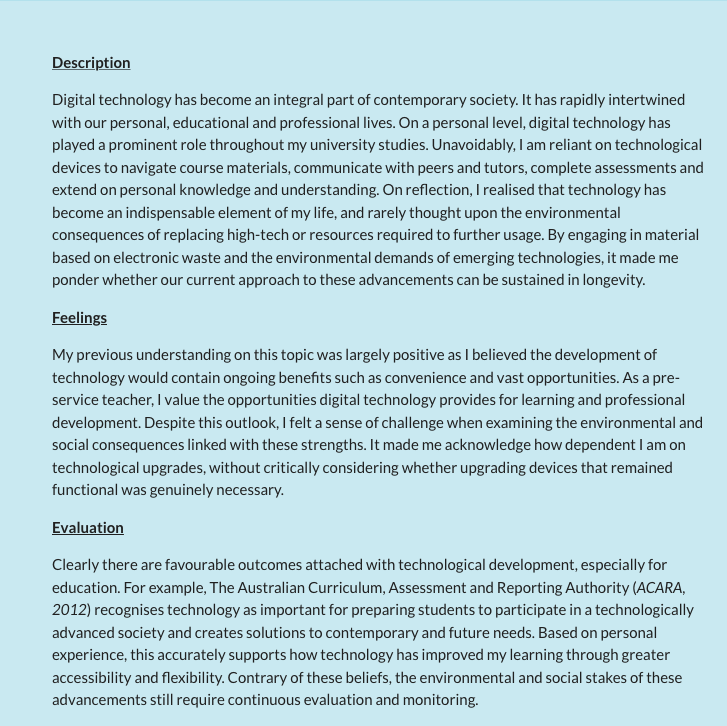
Description
Digital technology has become an integral part of contemporary society. It has rapidly intertwined with our personal, educational and professional lives. On a personal level, digital technology has played a prominent role throughout my university studies. Unavoidably, I am reliant on technological devices to navigate course materials, communicate with peers and tutors, complete assessments and extend on personal knowledge and understanding. On reflection, I realised that technology has become an indispensable element of my life, and rarely thought upon the environmental consequences of replacing high-tech or resources required to further usage. By engaging in material based on electronic waste and the environmental demands of emerging technologies, it made me ponder whether our current approach to these advancements can be sustained in longevity.
Feelings
My previous understanding on this topic was largely positive as I believed the development of technology would contain ongoing benefits such as convenience and vast opportunities. As a pre-service teacher, I value the opportunities digital technology provides for learning and professional development. Despite this outlook, I felt a sense of challenge when examining the environmental and social consequences linked with these strengths. It made me acknowledge how dependent I am on technological upgrades, without critically considering whether upgrading devices that remained functional was genuinely necessary.
Evaluation
Clearly there are favourable outcomes attached with technological development, especially for education. For example, The Australian Curriculum, Assessment and Reporting Authority (ACARA, 2012) recognises technology as important for preparing students to participate in a technologically advanced society and creates solutions to contemporary and future needs. Based on personal experience, this accurately supports how technology has improved my learning through greater accessibility and flexibility. Contrary of these beliefs, the environmental and social stakes of these advancements still require continuous evaluation and monitoring.
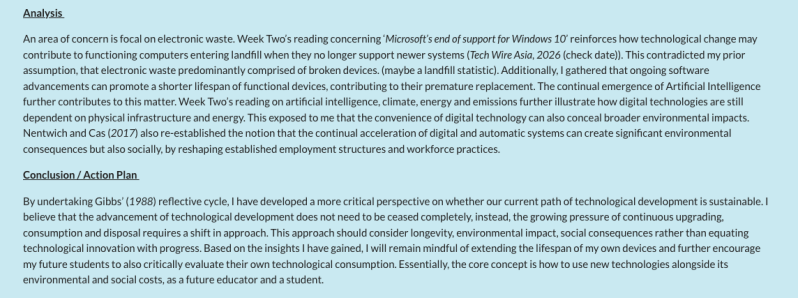
Analysis
A progressive concern is electronic waste. Week Two's reading 'Microsoft's end of support for Windows 10' reinforces how technological change may contribute to functioning computers becoming electronic waste when they are no longer supported by newer systems (Tech Wire Asia, 2026). This contradicted my prior assumption, that electronic waste predominantly comprised of broken devices. 1. This concern becomes heavily significant after reviewing evidence of the increasing volume of electronic waste being generated on a global scale. Statistics reveal that the world generated a record of 62 million tonnes of e-waste in 2022 and is set to reach 82 million tonnes by 2030 (ITU, 2026). Therefore, highlighting that technological disuse is not simply an individual matter, but a broader environmental challenge. Additionally, I gathered that ongoing software advancements can promote a shorter lifespan of functional devices, contributing to their premature replacement. The continual emergence of Artificial Intelligence further contributes to this matter. Week Two’s reading on artificial intelligence, climate, energy and emissions further illustrate how digital technologies are still dependent on physical infrastructure and energy. This exposed to me that the convenience of digital technology can also conceal broader environmental impacts. Nentwich and Cas (2017) also re-established the notion that the continual acceleration of digital and automatic systems can create significant environmental consequences but also socially, by reshaping established employment structures and workforce practices.
Conclusion/Action Plan
By undertaking Gibbs’ (1988) reflective cycle, I have developed a more critical perspective on whether our current path of technological development is sustainable. 2. I do not believe that the advancement of technological development needs to be ceased completely, instead, the growing pressure of continuous upgrading, consumption and disposal requires a shift in approach. This approach should consider longevity, environmental impact, social consequences rather than equating technological innovation with progress. Based on the insights I have gained, I will remain mindful of extending the lifespan of my own devices and further encourage my future students to also critically evaluate their own technological consumption. 3. This can be achieved by encouraging a classroom discussion based on whether new technologies would genuinely improve a process or product, rather than holding the assumption that "newer" automatically means better. 4. Essentially, I have recognised that technological progress requires a balance between embracing innovation and critically considering its environmental and social costs, as for both a future educator such as myself and students.
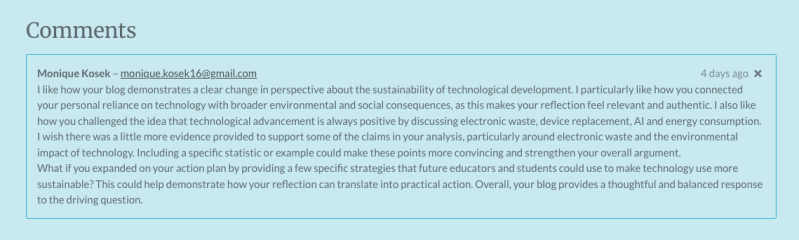
| 1. "This concern becomes heavily significant after reviewing evidence of the increasing volume of electronic waste being generated on a global scale. Statistics reveal that the world generated a record of 62 million tonnes of e-waste in 2022 and is set to reach 82 million tonnes by 2030 (ITU, 2026). Therefore, highlighting that technological disuse is not simply an individual matter, but a broader environmental challenge". | I integrated quantitative evidence based on peer feedback as they suggested to have stronger supporting evidence on electronic waste. I also believe this strengthened my analysis and claims as I was able to connect my personal feelings to evidence of the broader environmental consequences of technological consumption. |
| 2. "I do not believe that the advancement of technological development needs to be ceased completely". | Refined wording and sentence structure to improve clarity, academic expression and readibility. |
| 3. "This can be achieved by encouraging a classroom discussion based on whether new technologies would genuinely improve a process or product, rather than holding the assumption that "newer" automatically means better". | Expanded my action plan in response to peer feedback requesting specific strategies for sustainable technology use. I added a practical example relevant to my future teaching practice to demonstrate how my reflection could translate into meaningful professional action. |
| 4. "Essentially, I have recognised that technological progress requires a balance between embracing innovation and critically considering its environmental and social costs, as for both a future educator such as myself and students". | Refined wording and sentence structure to improve clarity, academic expression and readability. |
References
Australian Curriculum, Assessment and Reporting Authority. (2012). The shape of the Australian Curriculum: Technologies. Australian Curriculum, Assessment and Reporting Authority. https://docs.acara.edu.au/resources/Shape_of_the_Australian_Curriculum_-_Technologies_-_August_2012.pdf
International Telecommunication union. (2024). Electronic waste rising five times faster than documented e-waste recycling: UN. https://unitar.org/about/news-stories/press/global-e-waste-monitor-2024-electronic-waste-rising-five-times-faster-documented-e-waste-recycling
Nentwich, M., & Cas, J. (2017). Robots digitalisation and jobs (ITA Dossier No. 26en). Institute of Technology Assessment, Austrian Academy of Sciences. https://epub.oeaw.ac.at/?arp=0x00357f99
Raj, A. (2023). As Microsoft ends support for Windows 10, millions of PCs could end up in landfills. Tech Wire Asia. https://techwireasia.com/2023/12/end-of-microsoft-windows-10-support-pushes-millions-of-pcs-into-landfills/#:~:text=As%20Microsoft%20ends%20support%20for,could%20end%20up%20in%20landfills&text=The%20end%20of%20Microsoft%20Windows,likely%20end%20up%20in%20landfills.
University of Edinburgh. (2024). Gibbs' reflective cycle. Reflection Toolkit. https://reflection.ed.ac.uk/reflectors-toolkit/reflecting-on-experience/gibbs-reflective-cycle